
Elementary
Plan ahead with teachers, daycare providers and coaches.
For a parent of a child with Juvenile Arthritis, September’s approach means far more than just the buying of school supplies and new clothes. It also requires some special preparation for your child’s new teachers, daycare providers, coaches and more. Despite being such a common condition in children, many teachers are still unaware that kids can get arthritis and most will have had limited, if any, experience teaching children with this disease.

Talk to Educators
Your child’s teacher will be spending several hours each day with your child. They may notice physical or emotional changes that you haven’t seen at home.
We suggest you set up a meeting with your child’s teacher(s) within the first couple of weeks of the school year. Depending on the age of your child and how severe their disease, what you choose to discuss may differ.
Important topics to cover:
- What joints are affected and how the joint pain or stiffness may limit performance in school work or participation in classes such as physical education. Try to emphasize that symptoms may fluctuate over the course of the day, week or month.
- Which medications your child is taking and the side effects they experience as a result.
- Expectation of absences due to doctors appointments and late arrivals due to morning stiffness.
- Asking the teachers to report any symptoms that they observe during the school day
- Awareness of sadness or embarrassment as a result of your child being “different” from their peers.
Customizable Letters
The following toolkit has been designed to increase awareness of Juvenile Arthritis and other rheumatic diseases in school, and help parents and children communicate their needs to their educators. These resources for students, parents and teachers will help kids get back to what’s important at school – learning and having fun! Use the links below to view certain sections of the toolkit.
Just fill in the blanks, personalize the letter with information specific to your child, and start the conversation today!
School Checklist
This checklist, presented by Occupational Therapist Heather Best at Cassie and Friends 2018 BC Family Day, is designed to assist parents or teens, in consultation with their Pediatric Rheumatology care team, to communicate a student’s rheumatic disease school challenges and recommendations to their educators. Some Key Considerations:
Additional Resources
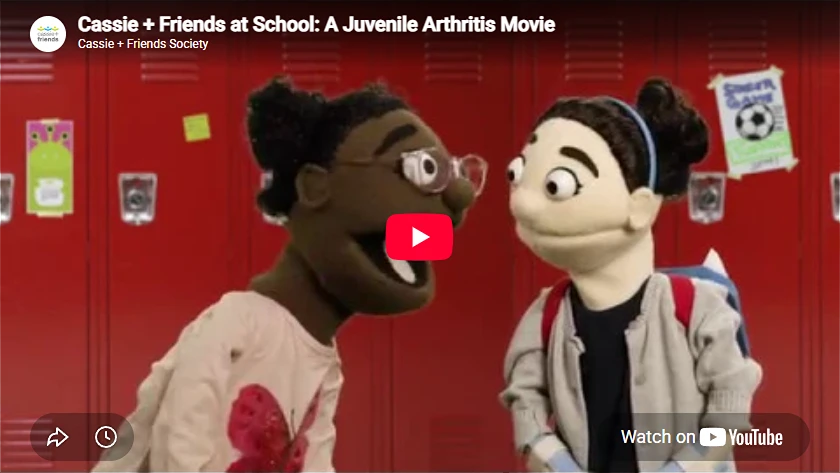
Juvenile Arthritis: The Movie
“The show brought such impact and awareness to the school. [After the show], the principal and teachers all wanted to help out my daughter and any other child [with JA] as much as they could now that they knew more about it.” — Parent
Bring JA Awareness to Your School
We took our LIVE in-school puppet show and turned it into a funny, upbeat 16-minute video to teach kids and teachers all about Juvenile Arthritis and how to be a good friend!
Along with the pain and confusion that comes with a Juvenile Arthritis or other rheumatic disease diagnosis comes the daunting task of explaining the life-changing condition to your child, family, teachers and friends.
Here’s how you can get started!
- Speak to your teacher about raising awareness of juvenile arthritis in your classroom.
- Use the Juvenile Arthritis Classroom Presentation Guide to share with your teacher what’s required.
- Practice makes perfect! If your getting involved, prepare a story or some information in advance.
- Let us know how it goes!
If you have any questions along the way, send us an email!
Elementary FAQs
Dr. Tommy Gerschman, Pediatric Rheumatologist specializing in pediatric sports medicine, exercise and health answers some FAQs about participating in sports and gym class.
How can I know what my child’s physical activity threshold is if they aren’t experiencing pain? Any suggestions for how to monitor them in this situation?
Many kids with arthritis actually don’t experience pain. If their arthritis is in remission then no need to limit. If they have mildly active disease then I usually don’t limit them too much. If they have big swollen joints then I try to limit heavy, pounding exercises such as running, jumping repetitively or from a height, trampoline, moguls etc. even if they don’t have pain. Some things to watch for can be the quality of the child’s movement. Even if they don’t verbally complain of pain you may see them alter how they are performing the movement if you watch closely (do they start to put more weight or use one limb more than the other). Another thing to look for is if they seem to be in pain later (they have done too much) or if they look stiff or painful in the joints the next morning. If any of these things are happening it is good to encourage a break in the activity. If you don’t notice anything until the next day or that night then reflect on what they did (ex. 2 hours of skating) and the next time plan to half that (1 hour of skating) and see how they do. It often is a bit of trial and error!
Do inflamed joints, ligaments, and tendons add to the risk of injury during activity?
There is an increased risk of injury for a few reasons. Inflammation can inhibit muscle firing making it harder for the muscles to stabilize and protect the joints. Inflammation over time can weaken the ligaments and tendons making them more susceptible to injury. Pain can make us compensate with other movements and therefore put us in a position that may make us more susceptible to injuries. During flares we usually encourage kids to be more careful with high impact/ contact sports.
When should we limit activity?
If you are in a flare it is a good time to take it a bit easier with activity. Doing light activity is ok but you may have to back off of the more intense activities. Pain can help remind you to take a break but not all kids experience pain as part of their arthritis or during activity. I remind families to look for signs that kids have done too much by noticing increased pain during or after the activity or increased pain or stiffness in the joints the next day. If these things happen it is important to think about what happened the day prior and try to do a bit less the next time.
How do we know when it is JIA pain vs other pains and how can we recommend activity limits when we are unsure?
This is one of challenges for children with JIA who play sports. It is a common question that your pediatric rheumatologist is asked and they can review individual circumstances. In general, JIA pain due to an active joint will be sore every day, regardless of activity, and it may be more significant in the mornings with associated stiffness. Any time there is a new pain associated with a sport it is recommended to take a moment to see if that pain persists or goes away. For any pain that is consistently coming up or lingers for a period of time after the activity, it is worth to review with your doctor and/or physiotherapist. Although there is some pain that is ok to “push through”, most of the time we have to learn how to listen to our body, adapt our activities accordingly, and get some help to figure out what’s going on.
What types of issues do children with JIA need to consider when playing sports?
Most children with JIA are able to continue to play sports without any significant problems. It is important to remember that not all joint or muscle pain is due to arthritis. The above recommendations for accommodation for PE classes can also be applied to sports participation. Many children want to fit in with their team and peers by not sharing their diagnosis but it is important to ensure at least the coaching staff is aware that a child has JIA. Similarly, coaches should be informed that, when well, most children with JIA will be able to participate, without restrictions, as well as other players.
Just like children returning from a sports injury, children who are returning to sport after a flare of arthritis should do so in a gradual manner. As with other children participating in sports, it is important to remember to have at least one day per week off their sports to allow for rest and recovery. Attention should also be considered for a well-balanced diet and adequate sleep.
Can children with JIA participate in sports?
Children with JIA can participate in sports at all levels of play. Most children with JIA are able to participate in any sport, although accommodations are sometimes needed as described above. Sports provide much needed physical activity and opportunities for socializing and goal-setting. Children with JIA have gone on to compete in international competitions at the most elite levels, play professional sports, and be professional dancers.
What are some of the accommodations a school should try to provide for children with JIA?
Schools are able to accommodate for a child with JIA to allow them to participate in PE classes. The teacher should be made aware that the child may need to sit out of some or all activities from time to time when there is a flare of arthritis or symptoms are worse. At other times, the child will be able to participate fully without any restrictions. Children are usually quite good at being able to self-direct such participation. Other accommodations might include alternative activities such as walking instead of running, learning a skill rather than participation in a full game, or participating in components of the activity. During a flare or increased symptoms, a child might also benefit from taking frequent breaks throughout the class. It is important to encourage participation when appropriate and also support the child in building confidence in physical literacy skills.
When should a child with JIA be excused from PE or gym class?
Children with JIA have, from time to time, a number of valid reasons to be excused from participation in PE or gym class. Children with JIA can have increased aches and pains in muscles or joints that make participation in certain types of physical activity (e.g. running, jumping) difficult. Other times, stiffness or restriction of range of a joint might also limit certain types of activities for a child. These symptoms can come and go at various times throughout the course of their chronic disease.
Furthermore, during a new or worsening flare of arthritis, when the joint is very swollen and tender, it is often a good idea to back off of some of the physical activities, including PE classes and other sports. In addition to increased pain, when a joint flare is occurring, the muscles around the joint are often not working as effectively and could pre-dispose a child to other sports injuries. More gentle activities, such as swimming or walking, can still be done quite safely.
Can children with JIA participate in PE or gym classes at school?
Yes! Physical activity is key to healthy development of children, including those with JIA. Current Canadian guidelines recommend that children aged 5-17 years of age participate in at least 60 minutes of moderate-vigorous physical activity per day. For at least three of these days the activities should promote muscle and bone strength. PE classes at school can contribute to these goals and also teach children important skills such as throwing, running, catching, jumping, and others. Learning to have fun with participation in either individual or team sports is also an important benefit of PE classes. Children with JIA have the same benefits and need for physical activity as other children. In fact, children with JIA might benefit even more from the overall strengthening of muscles and bones that comes from physical activity. Children with JIA can safely participate in sports without fear of exacerbating their disease, but there are some accommodations that should be considered in certain circumstances.
School Videos
Video resources for students, families, and educators.
School can look different for every student. Some families are managing morning stiffness, pain, and fatigue. Others are working through teacher communication, missed classes, friendships, gym participation, or learning how to ask for support.
These videos help families hear from others who have been there — and remind students that support, confidence, and connection are possible.
School Tips from Experts
Get expert advice and recommendations from an occupational therapist, a parent, a school administrator and a young adult with JIA as they host a panel on School Solutions and Educational Rights, held at Cassie and Friends 2018 BC Juvenile Arthritis Family Day. They cover a variety of issues including how to effectively communicate with educators, what school accommodations your child might benefit from and an overview of your child’s educational rights.
School Success with JIA
Hear from kids, youth and parents on how they navigated school, friendships, teacher communications, physical education and more with Juvenile Arthritis and other rheumatic diseases.

Medical Educational Video – Arthritis Society
Through the voices of children and teens living with juvenile idiopathic arthritis (JIA), this video gives teachers and others a better understanding of how arthritis affects students. It also offers suggestions for how to make school a friendlier and more welcoming place for someone living with JIA.