“Every furrow of her brow makes me want to stop”
If you have ever struggled to give your child an injection or to manage your child’s – or your own – emotions about their treatments, you are not alone!
In the lead up to our Methotrexate session, we talked with Yvonne Brandelli, PhD Student, Dalhousie University about her research looking at the impact of JIA pain and its treatments on parents.
“Through my research, we identified several ways JIA treatments impact parents, from their overall well-being to effects on their relationships” said Brandelli. “We also found that parents who feared their child’s pain tended to report more difficulties consistently following their child’s treatment plans – particularly when their child was receiving more painful treatments like injections.”
A challenge for many
Research suggests that depending on the treatment, up to 48% of newly diagnosed children and families with JIA may struggle to adhere to – or stick with – that treatment regularly.
A difficult balance for some
Despite knowing what’s best for their child in the long term, some parents struggle to see their child in pain and/or administer painful treatments (e.g., injections and infusions) in the short term.
Brandelli’s greatest hopes are to use the knowledge gained from her study to increase awareness around the impact that JIA treatments can have on parents, to normalize this experience, and to bring about hope and change in families.
“When families report regularly following treatment plans, we see kids with less pain, fewer symptoms, and a better ability to be involved in day to day activities such as going to school, and hanging out with friends,” says Brandelli. This likely even impacts children as they begin to develop their own self-management skills. “Our next step is to build on this research and work with partners like Cassie + Friends to advocate for the supports that kids and parents need to be successful with their treatment plans.”
Here’s how you can put Brandelli’s research into action:
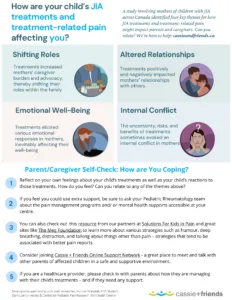
- Take a look at the graphic below, Ways your child’s treatment plan might be affecting you, and reflect on your own feelings about your child’s treatments as well as your child’s reactions to those treatments. How do you feel? Can you relate?
- If you’re feeling overwhelmed or struggling to cope, be sure to ask your Pediatric Rheumatology team about pain management programs and/ or mental health supports you can access.
- You can also check out this resource from our partners at Solutions For Kids in Pain and great sites like The Meg Foundation to learn more about various strategies such as humor, deep breathing, distraction, and talking about things other than pain – strategies that tend to be associated with better pain reports.
- Sometimes, just talking to another parent who understands can make a world of difference. Consider joining Cassie + Friends Online Support Network to meet other parents in a safe and supportive environment.
- If you are a healthcare provider, please check in with parents about how they are managing their child’s treatments – about whether they need any support.
Ways your child’s treatment plan might be affecting you
Through interviews with mothers of children with JIA across Canada, Brandelli identified four key themes for how JIA treatments and treatment-related pain might impact other parents and caregivers.